
A dental flosser is a tool designed to clean the spaces between teeth and along the gumline where a toothbrush cannot reach. The category includes traditional string floss, floss picks, and water flossers, each removing plaque, food debris, and biofilm that drive cavities, gingivitis, and bad breath. Daily flossing supports oral hygiene because brushing alone cleans about 60% of tooth surfaces, leaving interdental areas vulnerable to plaque maturation and tartar formation within 24-72 hours.
The right flosser depends on individual conditions such as string floss suits tight contacts, water flossers help with braces and implants, and soft tape or floss picks suit sensitive gums and limited dexterity. Correct technique matters as much as device choice, since aggressive flossing can cause gum trauma and recession. Persistent bleeding, swelling, or chronic bad breath signal the need for professional dental evaluation rather than home flossing alone.
What Is a Dental Flosser?
A dental flosser is an oral hygiene device used to remove plaque, food particles, and bacterial biofilm from between teeth and along the gum line. The category includes three main formats; traditional string floss (a thin filament drawn manually between teeth), floss picks (single-use plastic holders with a pre-stretched floss segment), and water flossers (electric devices that direct a pulsed stream of water at interdental areas).
A dental flosser is the broad category that covers all interdental cleaning tools, while a water flosser refers specifically to a device that uses pressurized water rather than physical floss. The two are often confused. Mechanical flossing scrapes adherent plaque from tooth surfaces, whereas water irrigation flushes debris and disrupts loose biofilm with hydraulic force.
Interdental areas account for roughly 35-40% of total tooth surface and remain inaccessible to bristles regardless of brushing technique, which is why flossers form a core component of dental hygiene alongside how to brush teeth correctly and mouthwash use.
How To Floss Teeth Properly Without Damaging Your Gums
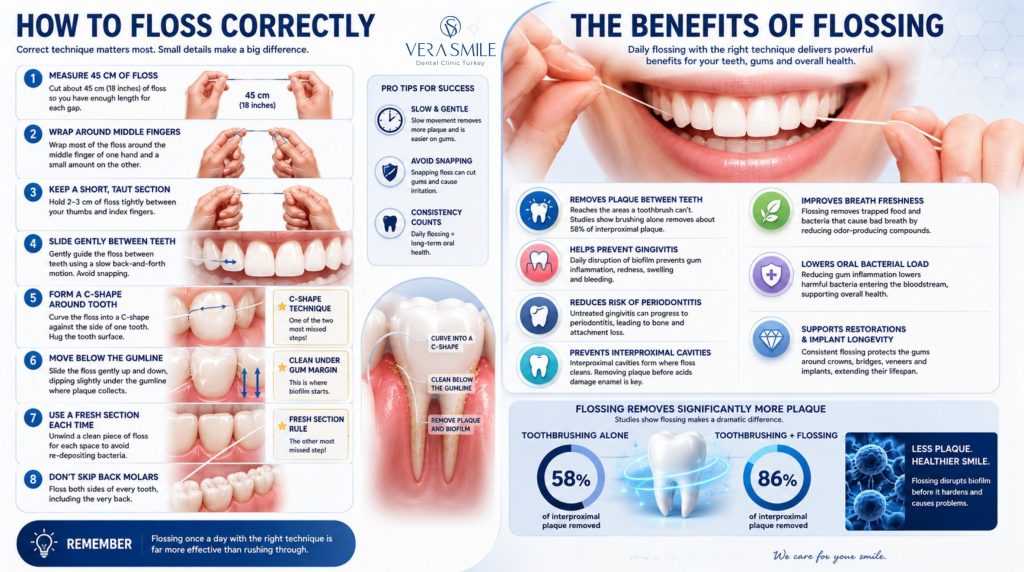
Proper flossing requires a 45-50 cm length of floss wrapped around the middle fingers, gentle insertion between teeth, and a C-shape motion that hugs each tooth without snapping the floss into the gum. Technique matters because aggressive flossing causes more gum damage than skipping floss entirely.
- Correct Floss Length: Use 45 to 50 cm of floss so a fresh, unused section can be advanced between each pair of teeth.
- C-Shape Technique: Curve the floss around each tooth in a C-shape and slide it up and down the side of the tooth, rather than sawing horizontally across the gum.
- Gumline Movement: Move the floss gently below the gumline by about 2-3 mm to disrupt subgingival plaque without forcing the tissue.
- Gentle Pressure: Apply light pressure as the floss passes the contact point, never snapping it down onto the gum.
- Clean Floss Sections: Rotate to an unused segment of floss between every two teeth to avoid transferring bacteria from one site to another.
Common beginner mistakes include sawing back and forth, using the same section for the entire mouth, and stopping after one episode of bleeding gums. Mild bleeding usually resolves within 1-2 weeks of consistent flossing as gum inflammation subsides.
How Do You Use a Water Flosser Correctly?
A water flosser is used by starting at the lowest pressure setting, holding the tip at a 90-degree angle to the gumline, and tracing along each tooth for 2-3 seconds before moving to the next. Begin at the lowest pressure for the first week, then increase gradually as gum sensitivity adapts. Lean over the sink with lips slightly parted to let water flow out, and complete the routine in 60-90 seconds. Pointing the tip directly into the gum pocket at high pressure can cause irritation and detach the gum from the tooth.
Why Is Flossing Necessary Even If You Brush Your Teeth?
Flossing is necessary because toothbrush bristles cannot enter the contact areas between teeth, which contain roughly 35-40% of total tooth surface and trap food, plaque, and bacteria. Without interdental cleaning, plaque matures, hardens into tartar within 24-72 hours, and triggers gingivitis, tooth cavity formation in interproximal areas, and eventual gum recession.
Peer-reviewed research shows interdental cleaning reduces gingival inflammation by 30-50% compared with brushing alone. The bacterial load between teeth has also been associated with systemic conditions including cardiovascular disease and diabetes, since oral bacteria and inflammatory markers can enter the bloodstream through inflamed gum tissue. Persistent bad breath is another indicator of interdental bacterial accumulation that brushing cannot resolve on its own.
How Does a Dental Flosser Actually Remove Plaque and Bacteria?
A dental flosser removes plaque by mechanically disrupting the bacterial biofilm that adheres to tooth surfaces and gumline crevices. String floss scrapes the biofilm off, while a water flosser dislodges loose debris and weakens biofilm structure with pulsed hydraulic pressure.
The distinction matters, rinsing or chewing can remove visible food particles, but only mechanical contact or pressurized irrigation breaks the matrix of mature plaque, which is a structured community of bacteria embedded in extracellular polymers. When plaque is not removed within 24-72 hours, calcium phosphate from saliva mineralizes it into tartar, a hardened deposit that only a dental professional can remove. The gumline is the highest-yield zone for flossing because subgingival bacteria drive most chronic inflammation.
Dental Floss vs Interdental Brush vs Water Flosser
Dental floss, interdental brushes, and water flossers are the three main tools for cleaning between teeth, and each suits a different anatomical situation. The table below compares them across the factors that matter most when choosing.
| Factor | Dental Floss | Interdental Brush | Water Flosser |
| Best For | Tight contacts in healthy natural dentition | Larger gaps, exposed roots, between implants | Braces, implants, bridges, limited dexterity |
| Effectiveness on Plaque | High in narrow spaces | Higher than floss in open spaces | Moderate; flushes rather than scrapes |
| Effectiveness on Gum Health | Good with correct technique | Strong evidence base for periodontal patients | Strong for orthodontic and implant patients |
| Suitability for Braces / Implants / Bridges | Requires threaders or super floss | Suits most configurations directly | Easiest for complex appliances |
| Cost | Lowest | Low, reusable for ~1 week per brush | Highest (device + ongoing electricity) |
| Ease of Use | Steepest learning curve | Moderate | Easiest |
A meta-review on mechanical plaque removal concluded that interproximal cleaning using interdental brushes, floss, wood sticks, and oral irrigators maintains interproximal gingival health, with moderate evidence that interdental brushes remove more plaque than toothbrushing alone and weaker evidence specifically for floss. In practice, periodontists often recommend combining methods, floss for the tight contacts where a brush will not fit, and an interdental brush or water flosser for the open spaces and the dental work, rather than picking a single tool.
What Mistakes Make Flossing Less Effective?
The most damaging flossing mistakes are aggressive technique, inconsistent frequency, and over-reliance on a single tool. Each mistake reduces plaque removal or directly harms gum tissue.
Aggressive flossing causes the majority of self-inflicted gum injuries seen in dental practice. Snapping the floss past the contact point drives it into the gum, and a back-and-forth sawing motion creates floss clefts, vertical splits in the gum tissue that gradually evolve into permanent recession. Floss should glide along the side of each tooth, not slice across the gum.
Why Is Inconsistent Flossing a Problem?
Inconsistent flossing allows plaque to mature into tartar, which home cleaning cannot remove. Within 24-72 hours, undisturbed plaque mineralizes into calculus, and within 2-3 weeks of irregular cleaning, gingival inflammation can progress to early gingivitis. Flossing two or three times a week does not maintain the daily disruption cycle that biofilm control requires, since the bacterial community regenerates within hours of removal.
Why Does Water Flossing Alone Not Fully Replace String Floss?
Water flossing alone does not fully replace string floss because pressurized water dislodges loose debris and disrupts surface biofilm, but it does not scrape the adherent plaque layer from tooth surfaces as effectively as physical contact. Clinical guidance positions water flossers as an excellent adjunct, particularly for braces and implants, and as a primary tool when string floss is impractical. Combined use produces the strongest plaque control in most healthy dentitions.
Can Dental Flossers Help With Bad Breath and Gum Disease?
Yes, dental flossers reduce both bad breath and the risk of gum disease by removing the food debris and anaerobic bacteria responsible for each condition. Daily flossing has been shown to decrease gingival bleeding by 30-50% within 2-4 weeks of consistent use.
Bad breath, or halitosis, is largely produced by anaerobic bacteria that break down trapped food particles and release volatile sulfur compounds. Interdental spaces and the tongue are the main reservoirs. Removing the trapped debris and disrupting bacterial colonies addresses the root cause rather than masking the odor, which is why mouthwash alone often fails to resolve bad breath after brushing teeth.
For gum disease, the bacterial biofilm at the gum line triggers the inflammatory cascade that defines gingivitis and, untreated, periodontitis. Flossing daily disrupts this biofilm before inflammation becomes chronic, reducing the eventual need for deep cleaning teeth procedures.
Are Water Flossers Scientifically Proven to Work?
Water flossers are supported by peer-reviewed clinical evidence showing significant reductions in plaque, gingival bleeding, and probing depth when used consistently. Multiple randomized studies report water flossers reducing gingival bleeding by 50-70% over 4 weeks compared with brushing alone, and they perform comparably to or better than string floss in patients with orthodontic appliances or implants.
Effectiveness depends on two variables, daily consistency and correct technique. A water flosser used twice a week with the tip held incorrectly produces marginal benefit, while a device used daily at the gumline with proper angulation can match or exceed traditional flossing outcomes in many populations.
Who Benefits Most From Using a Water Flosser?
Water flossers offer the greatest benefit to users with orthodontic appliances, dental implants, periodontal pockets, sensitive gums, and limited manual dexterity. In these groups, mechanical string flossing is either impractical or carries a higher risk of soft tissue trauma.
Are Water Flossers Good for Braces?
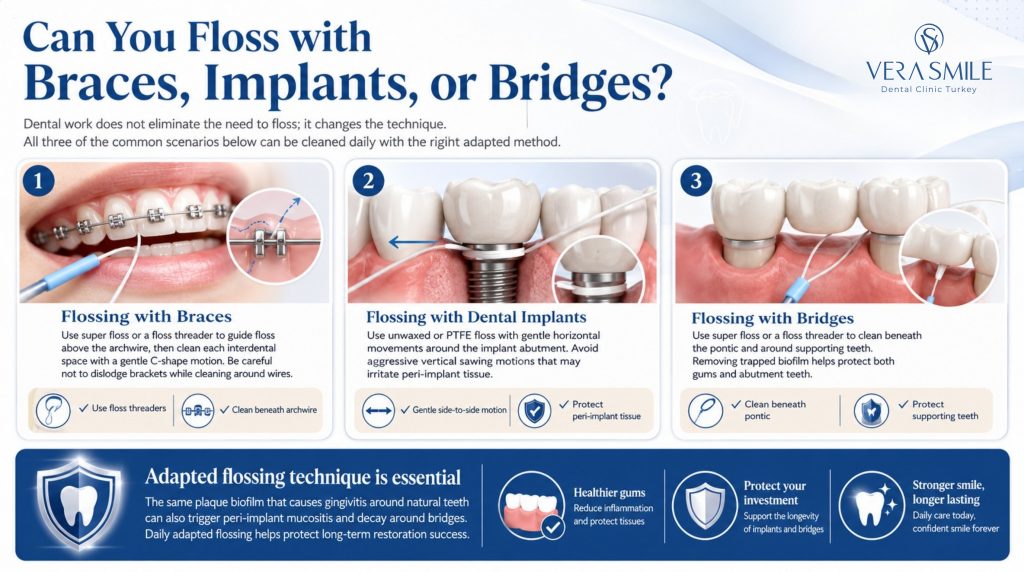
Water flossers are particularly effective for braces because the pulsed water stream cleans around brackets, wires, and ligatures that string floss cannot navigate without threaders. Clinical studies in orthodontic patients show water flossers remove up to three times more plaque around brackets than manual brushing alone, lowering the risk of white spot lesions and gingivitis during treatment.
Can People With Dental Implants Use Water Flossers?
People with dental implants can use water flossers, and most periodontists recommend them as part of peri-implant hygiene. The pressurized water cleans the implant-abutment junction and the gum pocket around the implant without scratching the titanium surface, which stiff interdental brushes can do if used aggressively. Maintaining peri-implant tissue health is essential, since peri-implantitis is the leading cause of late implant failure. Standard dental implants aftercare protocols include daily water flossing at low to medium pressure.
Are Water Flossers Better for Sensitive or Bleeding Gums?
Water flossers are often better tolerated by users with sensitive or bleeding gums because the gentle irrigation cleans the gum line without the friction and pressure of physical floss. For early-stage gingivitis where any contact triggers bleeding, water flossing at low pressure allows daily cleaning while inflammation subsides, often within 2-3 weeks of consistent use.
Are There Risks or Side Effects of Improper Flossing?
Improper flossing can cause gum trauma, bleeding, recession, and bacterial infection, though most risks are preventable with correct technique. The main hazards relate to excessive force, contamination of the device, and ignoring warning signs.
Mechanical trauma from snapping or sawing floss causes immediate cuts and long-term floss clefts that contribute to gum recession. Light bleeding during the first 1-2 weeks of new flossing generally reflects existing inflammation that resolves with continued cleaning. Bleeding that persists beyond 2 weeks, recurs heavily, or is accompanied by swelling, pain, or pus warrants professional evaluation through periodontics.
Water flosser reservoirs can harbor bacteria and biofilm if not cleaned regularly. The tank should be emptied after each use and washed weekly, and the tip should be replaced every 3-6 months. Using contaminated water under pressure can introduce bacteria into already inflamed tissue.
When Should You See a Dentist Instead of Relying on Flossing Alone?
A dentist should be consulted when symptoms persist despite daily flossing, including bleeding that lasts more than 2 weeks, gum swelling, loose teeth, chronic bad breath, visible recession, or pain when chewing. These signs indicate that home cleaning cannot resolve the underlying issue.
Tartar buildup, once formed, requires professional teeth scaling and polishing since calculus is too hard for any home device to remove. Established periodontal disease often requires deep cleaning teeth, evaluated by periodontics specialists, which addresses sub-gingival deposits and irrigates pockets that home flossing cannot reach. Routine dental check-ups every 6 months remain the standard recommendation even for users with strong home hygiene routines.
FAQ’s
Flossing does not create gaps between teeth when performed correctly. Healthy teeth and gums maintain natural contact points that floss passes through without separating. If a small space appears after starting a flossing routine, it is more likely caused by inflamed gum tissue shrinking back to a healthier position once daily cleaning begins, revealing the actual tooth structure rather than creating new space.
Children can use water flossers from approximately age 6, with parental supervision and the lowest pressure setting. Many manufacturers offer child-specific tips and reduced pressure modes designed for smaller mouths and developing gum tissue. Children wearing braces benefit particularly from water flossers, since manual flossing around orthodontic appliances is difficult for younger users to perform correctly.
A water flosser can be used safely with dental veneers, crowns, and bridges, and it is often recommended to maintain the margin between the restoration and natural tooth. Plaque accumulation at this margin is a leading cause of secondary decay and gum inflammation around restorations. The water stream cleans these areas without dislodging properly bonded restorations or scratching ceramic surfaces.
Flossing helps prevent cavities between teeth by removing the plaque and food debris that cause interproximal decay. Cavities between teeth are common because brush bristles cannot reach these surfaces, leaving acid-producing bacteria undisturbed. Combined with fluoride toothpaste and regular dental check-ups, daily flossing significantly reduces the rate of interproximal tooth cavity formation.
Lukewarm water is the standard fill for a water flosser and is comfortable for most users, particularly those with sensitive teeth. Diluted antimicrobial mouthwash can be used in the reservoir for short periods under dental guidance, though most manufacturers recommend rinsing the device thoroughly afterward to prevent residue buildup and damage to internal seals.
Flossing before brushing is supported by current evidence as the more effective sequence. Loosening interdental plaque first allows fluoride from toothpaste to reach the spaces between teeth during brushing, improving cavity prevention. A study published in the Journal of Periodontology found that flossing followed by brushing reduced interdental plaque significantly more than brushing followed by flossing.